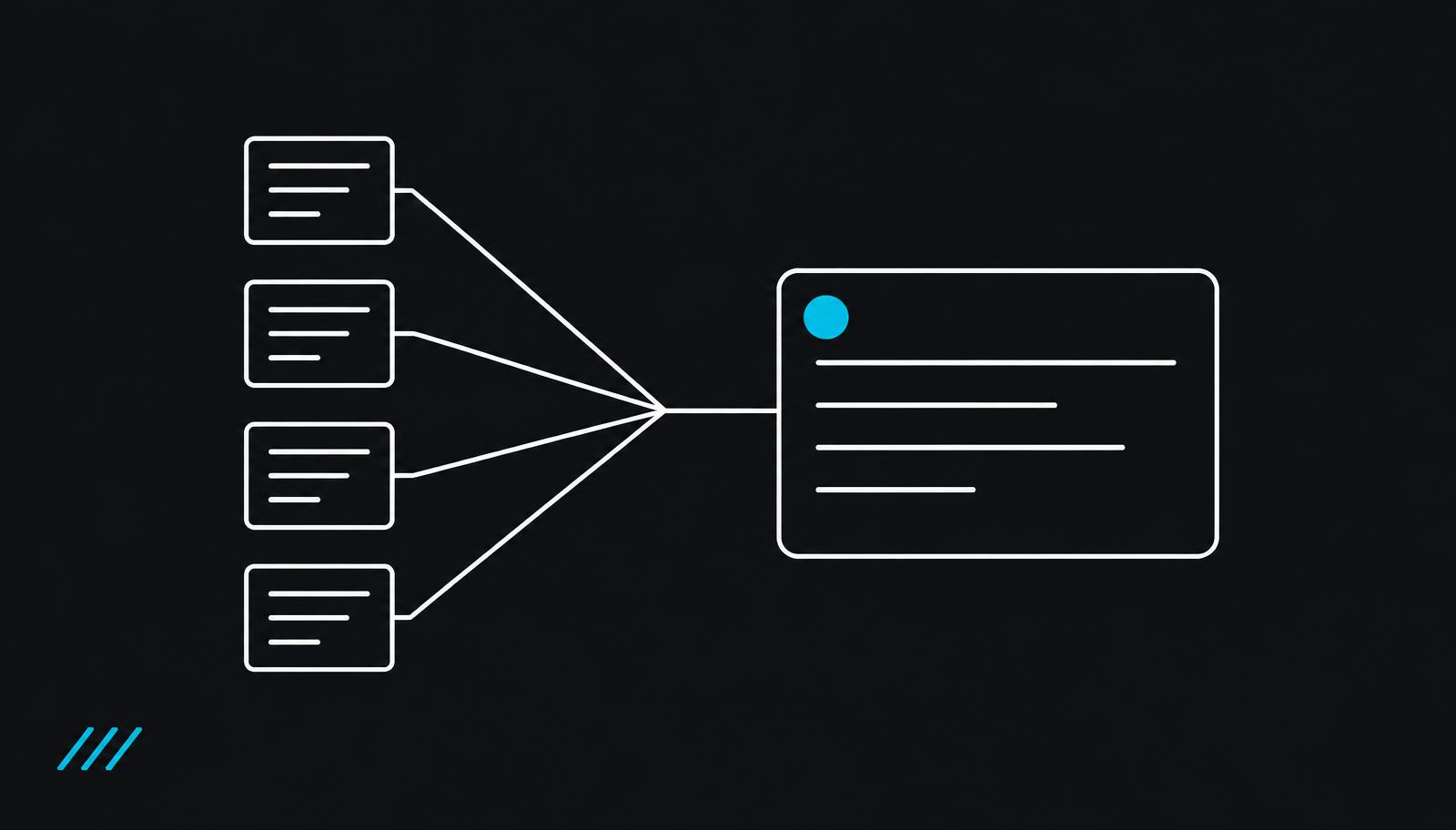
Google AI Overviews can display an AI-generated answer above traditional search results, with links to websites that support or expand on that answer. For businesses, the obvious question is: how can your website become one of those sources?
Short answer: Google has not published a formula that guarantees source citations in AI Overviews. It has, however, confirmed the fundamentals. A supporting page must be indexed and eligible for a snippet in Google Search. Relevant, useful, original content and sound technical SEO still matter. AI Overviews and AI Mode may also perform several related searches to gather supporting information and links.
Understanding these principles is more useful than chasing supposed GEO secrets.
What are Google AI Overviews?
AI Overviews are summaries generated by Google for certain searches. They are designed to help people understand complicated questions and explore useful websites.
They do not appear for every query. According to Google, an AI Overview appears when its systems determine that it adds something beyond the conventional search experience. Different questions and systems may produce different links and answers.
AI Mode is related but distinct. It is built for more complex questions, comparisons and follow-up exploration. Google says AI Mode and AI Overviews may use different models and techniques, so they should not be treated as identical search products.
What has Google actually confirmed about source selection?
Three parts of the process are especially relevant to publishers.
1. Your page must first be eligible for Google Search
To appear as a supporting link in an AI Overview or AI Mode, Google says a page must be indexed and eligible to appear in Search with a snippet.
In practice, check the following:
- Googlebot is not unintentionally blocked by robots.txt or your hosting and security infrastructure.
- Relevant pages do not carry accidental
noindextags or restrictive snippet controls. - Important information is available in crawlable text.
- Internal links help Google discover and understand your pages.
- Canonical URLs and the page structure are consistent.
An XML sitemap can help discovery, but inclusion in a sitemap is not proof that a URL is indexed or will receive a citation.
2. Google may investigate multiple related subtopics
Google describes a process called query fan-out. AI Overviews and AI Mode can issue several related searches across subtopics and data sources while forming a response.
Imagine someone asking, ‘How can my business become more visible in AI search?’ Related subtopics might include technical crawlability, helpful content, authority signals, measuring AI visibility and the role of SEO.
This is an illustrative example, not a verified list of searches Google performs for that particular question.
The practical implication is that a page offering a clear and well-supported answer to a useful subquestion can be relevant. It does not mean every article should be artificially broken into dozens of short text chunks.
3. Google looks for links that support the generated answer
Google explains that its systems can identify additional useful pages while generating an AI response, allowing links to different supporting websites.
That does not establish a rule such as ‘the top-ranked page always receives the citation’. Google does not publicly disclose a complete weighting system or fixed threshold for which pages become AI Overview sources.
Any agency promising a guaranteed citation based on a handful of tricks is claiming more certainty than the official documentation supports.
Sources: Google, AI features and your website and Google, Optimizing for generative AI search.
What makes content a stronger candidate for discovery?
There is no public checklist that guarantees an AI citation. Still, Google's quality and search documentation points to sensible priorities.
Give a complete answer to a real question
A useful article makes the reader's problem clear and provides the central answer early. It then explains the method, important exceptions and practical implications.
For example, a page about measuring AI visibility is more helpful when it explains which signals to record and how to compare results than when it only repeats that AI is changing search.
Add information that is not interchangeable with every other article
Original research, reproducible experiments, first-hand observations, clear examples and transparent methods can make content more useful.
Not every blog post requires an academic study. A thoughtful comparison of two approaches, with its assumptions and limitations stated, may also provide genuine value.
Do not invent statistics, customer outcomes or expert quotes to create a false impression of authority.
Make the publisher identifiable
Consistent company details, a clear About page, accessible contact information and honest information about the author or publisher help readers evaluate what they are reading.
These are not guaranteed AI-citation factors. Their immediate value is that the content comes from an identifiable, accountable business rather than an anonymous content operation.
Keep technical SEO strong
Use readable URLs, meaningful headings, relevant internal links, correct indexing settings and mobile-friendly pages.
Structured data such as Article markup can provide useful context where it accurately reflects the visible page. However, Google explicitly says that no special schema or additional AI-specific text files are required for AI Overviews and AI Mode.
A five-point website audit for AI Overviews
Before investing in more GEO content, review these areas.
| Check | Question | Recommended action |
|---|---|---|
| Indexing | Is the important URL indexed by Google? | Investigate issues in Search Console. |
| Access | Can Googlebot retrieve the relevant content? | Check robots.txt, hosting blocks and snippet controls. |
| Answer quality | Does the page solve a recognizable question? | Make the central answer clear; add examples and relevant context. |
| Internal structure | Is the page connected to related services and articles? | Add useful, descriptive internal links. |
| Originality | Does the page contribute something distinctive? | Add your method, evidence, analysis or a meaningful comparison. |
These checks improve the foundations of both SEO and GEO. You do not need to build two disconnected content systems.
How can you tell whether Google actually shows your pages?
Since 2026, Google Search Console has offered dedicated reporting for generative AI features. It allows publishers to examine URL impressions in Google's AI search experiences, with breakdowns that include pages, countries and dates.
That is more informative than running one search and saving a screenshot. It still does not disclose exactly why one URL was selected over another, nor does it measure citations in ChatGPT or Perplexity.
For a broader baseline, combine Search Console with repeatable tests across platforms. Our companion guide, How to Measure AI Search Visibility, explains the process.
Source: Google Search Central, Generative AI performance reports.
Which supposed GEO tricks should you avoid?
Be skeptical of claims such as:
- ‘Add an
llms.txtfile and Google will cite you more often.’ - ‘Install special GEO schema to appear automatically in AI Overviews.’
- ‘Split every paragraph into artificial chunks and AI will understand it better.’
- ‘Buy an AI mentions package to gain instant authority.’
Google recommends applying established SEO principles to generative search and warns against unsupported tactics. There is no publicly available guaranteed path to an AI Overview citation.
Frequently asked questions
Does Google only cite websites in the top ten organic results?
Google has not published a universal rule requiring a page to rank in the top ten. The stated baseline is that a page must be indexed and eligible to appear in Search with a snippet. Citation is not guaranteed.
Do I need special structured data for AI Overviews?
No. Google says no special schema.org markup is required. Use regular structured data when it accurately represents visible content.
Is GEO different from SEO?
GEO focuses on visibility in generative search experiences. Much of the practical work overlaps with SEO: content quality, indexing, relevance and technical accessibility. Some presentation formats and measurement approaches differ.
Can I force Google to cite a particular page?
No. You can improve discoverability and usefulness, but Google decides whether an AI Overview appears and which supporting links are shown.
Conclusion
The exact source-selection process behind each Google AI Overview is not public. What Google has confirmed is enough to guide sensible action: create indexable pages, provide clear and reliable answers, add original value and make useful content easy to discover.
AEO DIRECT helps businesses apply these fundamentals through a practical combination of GEO, AEO and SEO. Explore our GEO services and SEO services or get in touch.